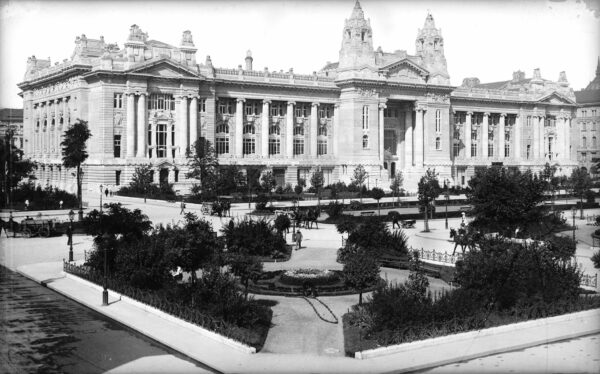
The first Hungarian stock exchange, the Pesti Commodity and Stock Exchange, started its operations on 18 January 1864. It first operated in the Lloyd Palace in Pest, built in 1830. By 1870, however, it had become so important that it had to move to a new building: the next location of the Exchange was the building built between 1870 and 1872 on the corner of Wurm Street (today Szende Pál Street) and Mária Valéria Street (today Apáczai Csere János Street).
The stock exchange, led by Zsigmond Kornfeld, outgrew the building on Wurm Street, thanks to its extraordinary development. In 1898, Kornfeld therefore asked the Minister of Finance, László Lukács, for a plot of land to build a new stock exchange building. A public tender was launched in 1899 for the building on the site, which received 33 entries. Ignác Alpár won the right to build the building with his historicist, late eclectic concept. After months of refinement, the building was constructed on Liberty Square from 1902. Even before the stock exchange building was built, the square was an important political and administrative centre: the Hungarian National Bank, the Post Office and the Hungarian Trade Hall were located here.
For the construction, the stock exchange took out a mortgage loan of four million crowns. The construction was carried out by the Grünwald brothers and the firm of Miksa Schiffer. Interestingly, the building was only granted a 30-year tax exemption if it could be made habitable by 1 August 1905. This may have something to do with the fact that, despite the extensive work and the workers' strike, although construction was not completed until 1907, the stock exchange moved into the building in the autumn of 1905. The building work was made possible by the demolition in 1897 of the huge barracks, the so-called Neugebäude, in one of the courtyards of which Prime Minister Lajos Batthyány had been executed in 1849.
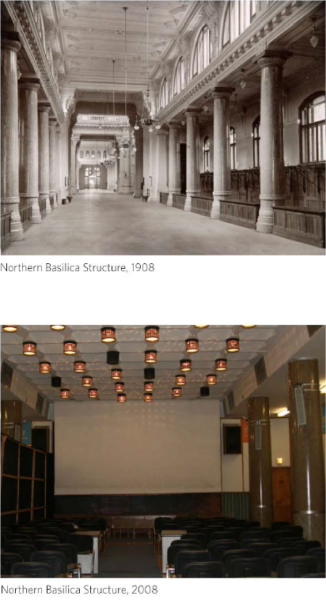
The building was extremely impressive in size: apart from the 9000 m2 145 m long and 60 m wide. Its imposing dimensions made it the largest stock exchange building in Europe. The outer façades were decorated with tall stone columns and the main entrance on Liberty Square was surmounted by a tympanum and sculptural decorations. The central dome was 18.5 metres high and the two wings of the building housed the separate commodity and value exchanges. Inside, visitors were welcomed by a large foyer with corridors on either side leading to the stock exchange rooms. The rooms were lit by tall windows opening onto the street, and the floors were covered with linoleum and the corridors with cement tiles. Four courtyards provided light and ventilation. The central heating and ventilation system was modern, with the stock rooms heated by pulsed air heating. Several convenient staircases and lifts facilitated access. The interiors were decorated with glass roofing, rich stone carvings and representative wall coverings. Upstairs there was a lounge, a smoking room, a cafeteria and a library, but the building also housed a stock exchange, a café, a telegraph office and a post office. On the ground floor there were offices for rent.
The stock exchange operated in the building until 25 May 1948, when nationalisation stopped its operations for a few decades. The building housed first the Lenin Institute, then the Hungarian House of Technology, and from 1955 to 2009 Hungarian Television (co-tenanted with the House of Technology until 1972, then independently). However, due to its construction and equipment, the building was not suitable for television purposes, and several renovations were carried out from 1948 onwards. Firstly in the gallery, and then in the attic in the 1950s. In the 1960s and 1970s, the first and second floors, in addition to the gallery, underwent major alterations. Studio IV was built on the gallery between 1969 and 1972. The floor structure on the second floor, which formed the basis for the Channel 2 Studio, completed in 1987, was built between 1961 and 1964.
It is part of the history of the building that, although the stock exchange reopened in 1990, it has not returned to its former location. In 2006, the state sold the building to a Canadian company and, although a plan to convert the building into a luxury office building was granted planning permission in 2010, it never materialised. Interestingly, the building has been the location of several film shoots (Winged Manhunter 2049, Black Widow). The building was purchased from a Canadian company in 2013, partly by the Istituto per le Opere di Religione (commonly known as the Vatican Bank), which was planning to finance the project, and then at the end of 2024 by a private equity fund managed by Granite Fund Management for investment purposes.
Literature
https://www.otpedia.hu/lexikon/helyek/tozsdepalota-szabadsag-ter-legmarkansabb-epulete_2/
https://epiteszforum.hu/ugy-maradt-a-teveszekhazkent-ismert-tozsdepalota-tortenete
https://epiteszforum.hu/mitol-lesz-mas-ami-ugyanaz
https://pestbuda.hu/cikk/20170207_ujjaszulethet_vegre_a_tozsdepalota
https://pestbuda.hu/cikk/20190717_domonkos_csaba_a_tozsdepalota_kulonos_tortenete
Alpár, Ignác 1908: The Palace of the Budapest Commodity and Stock Exchange on Liberty Square. The Hungarian Engineers and Architects' Society Gazette 42 (1-2.) 1-5.
Nóra Németh - Katalin Marótzy: The two most important architectural tenders and press of the turn of the century I. The Budapest Commodity and Value Exchange. Architechtura Hungariae. Online website: http://arch.eptort.bme.hu/arch_old/hu/fooldal?id=34
Written by: Róbert Szabó
More photos






"What is needed is a serious, persistent will on the part of each of us, directed to visit, use and animate the young institution frequently, perhaps at first with some sacrifice of our habits, our desires and our interests."
Baron Frigyes Kochmeister (1816-1907)
President of the BSE (1864-1900)"As regards freedom of action, our institution desires nothing more than to do what is in the interest of the country as a whole, and to be free from any unilateral tendency, as it has been far from seeking to cultivate its own interests at the expense of the common good. "
Baron Zsigmond Kornfeld (1852-1909)
President of the BSE (1900-1909)"Our poor mother, this dismembered Hungary is sick, seriously sick, and let us put aside all other interests, real or apparent, and keep in mind the only point of view: what is necessary, what is good for our poor, sick mother: Hungary."