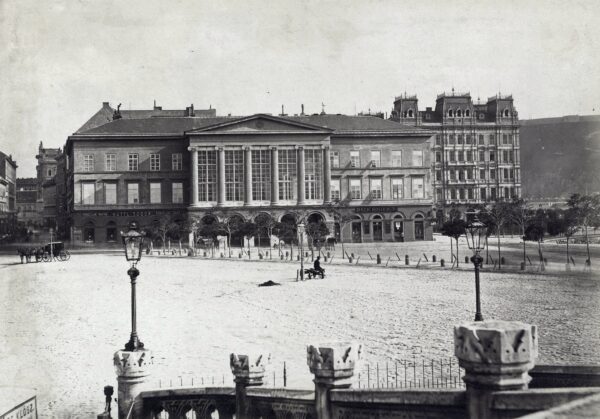
The headquarters of the former Pesti Civic Trade Board was designed by József Hild in 1826 in neoclassical style, after the board bought a plot of land in 1820 on the area bounded by the former Kirakodó Square, Dorottya Street and Maria Valeria Street. Construction lasted from 1827 to 1830. The main façade rested on huge pillars, and the three naves could be accessed through a ground-floor arcaded passageway, giving a view of the fountain and the courtyard.
The Commercial Hall was opened in the building on 7 March 1831, but the National Casino was also located there between 1830 and 1851. István Széchenyi also lived here between 1832 and 1836. The offices of the Hungarian Bank were located in one part of the building. During the War of Independence in 1849, the building suffered considerable damage and was almost completely burnt down, but it was restored.
Restored by 1850, the Grain Hall continued to operate in it. In 1851, it was renamed Lloyd Palace from the Pesti Lloyd Society, when the Society took over the Hall.In 1861, it became the meeting place of the House of the Estates, and from 1864 the Deák Circle also met here. In 1867, Queen Elisabeth watched the coronation from here. On 18 January 1864, the Pesti Commodity and Stock Exchange started its operations in this building.
The Lloyd Palace was once the seat of the General Council and the headquarters of the Libertarian Party led by Ferenc Deák.From 1875 the party's circle and club operated here. The building had traces of classicism, with two floors and a spacious courtyard. The Liberal Club consisted of nine rooms. The central meeting room was used for party meetings. It also provided a wide range of entertainment for politicians, with billiards, card rooms and reading rooms. The Libertarian Party used the building for twenty years, until 1905, when István Tisza dissolved it after the defeat of the governing party.
It was then acquired by the Trieste General Insurance Company and used until 1944. The building suffered extensive damage during the bombing of Budapest in 1945. Although it could have been salvaged, its iconic character led to its demolition: first the parts of the building that were life-threatening to passers-by were demolished, and then, in 1949, the building itself. It was reported in the press that the demolition had to be carried out by explosives, after a labourer died in a firewall collapse.
The building was for a long time a parking lot. In 1981-1982, the hotel, formerly known as the Atrium Hyatt, was built and is now known as the Sofitel. Its redevelopment was declared a priority investment in 2022 and the modernisation of the hotel is still ongoing.
Literature
László Berza (ed.): Budapest Lexicon. Budapest, 1973. 653-654.
https://pestbuda.hu/cikk/20210313_amikor_a_lloyd_palotaban_dolt_el_az_orszag_sorsa
Loránt Radnai 1947: the reorganisation of the Lloyd Palace area. Space and form 20. (6.) 122-124.
László Prohászka: Danube Corridor. Budapest Metropolitan Municipality, Mayor's Office. Budapest, 1998.
Written by: Róbert Szabó
More photos







"What is needed is a serious, persistent will on the part of each of us, directed to visit, use and animate the young institution frequently, perhaps at first with some sacrifice of our habits, our desires and our interests."
Baron Frigyes Kochmeister (1816-1907)
President of the BSE (1864-1900)"As regards freedom of action, our institution desires nothing more than to do what is in the interest of the country as a whole, and to be free from any unilateral tendency, as it has been far from seeking to cultivate its own interests at the expense of the common good. "
Baron Zsigmond Kornfeld (1852-1909)
President of the BSE (1900-1909)"Our poor mother, this dismembered Hungary is sick, seriously sick, and let us put aside all other interests, real or apparent, and keep in mind the only point of view: what is necessary, what is good for our poor, sick mother: Hungary."