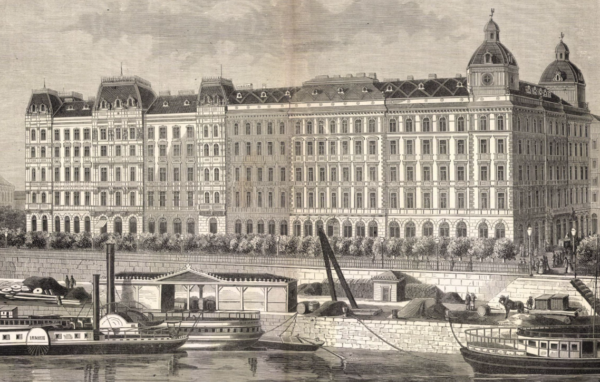
The history of the Stock Exchange Building on Wurm Street can be traced back to the development of the stock exchange. The Pest Commodity and Stock Exchange began operating on 18 January 1864, initially in the Lloyd Palace, built in 1830 and located in Pest.
The Lloyd Palace was once the seat of the House of Lords and the headquarters of the Liberal Party led by Ferenc Deák. The building suffered significant damage during the turbulent events of Hungarian history. First, it suffered significant damage in 1848, which was later repaired. Later, during the bombing of Budapest in 1945, it was so badly damaged that it became beyond repair: first, the parts that were dangerous to passers-by were demolished, and then, in 1949, the building itself was demolished.
Another location for the stock exchange was the building constructed at the corner of Wurm Street (now Sándor Wekerle Street) and Mária Valéria Street (now János Apáczai Csere Street). The building was introduced by Sunday Newspaper . The building was designed by Károly Benkó and Ferenc Kolbenheyer. Construction began in 1870, and different parts of the building were completed at different times: while the rental apartments were already available in November 1871, the Lloyd Club was only able to move in in November 1872. The grain hall, café and ground floor exchange room were completed in the spring of 1872. The construction of the building was problematic because part of the site between Ferenc József Square, Mária Valéria Street and Wurm Street was occupied by the four-storey Stein apartment building, whose height made it difficult to construct the stock exchange building without it appearing to be an „appendage” to the apartment building. This problem was solved by the towers of the new stock exchange building, which made the building stand out. (The apartment building was built between 1867 and 1871 and was owned by grain merchant Nathan Stein.)
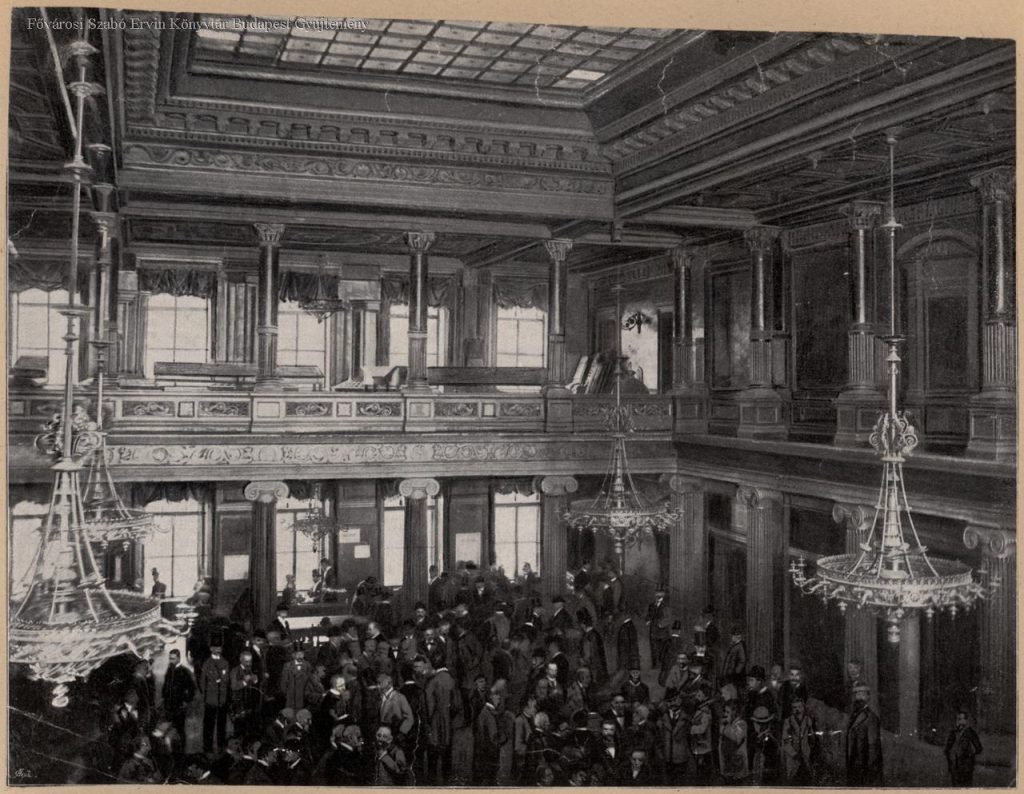
In terms of the building's interior features, flats were created on the second, third and fourth floors as rental properties. The grain hall was located on the ground floor overlooking the Danube: the larger milling businesses had one window each, while private traders had one drawer each. The café faced Mária Valéria Street. In the courtyard, a large, ornate outbuilding and separate staircases served the residents of the apartment buildings. The floor of the building was made of thick glass, as there was a separate café on the ground floor and a dining room and beer hall on the Danube side. The Lloyd Club rooms were located on the first floor. The route led from the cloakroom to the lounge and from there to the reading room. The Sunday Newspaper noted that this was perhaps the most beautiful view of the Danube. The larger joint-stock companies held their meetings in the club's meeting room, which also overlooked the Danube. On the other side, there was a billiard room and seven games rooms. The lobby of the large stock exchange hall was located on the Stein House side, which served the most important function of the stock exchange. On the main façade overlooking the Danube, the inscription "Magyar Kereskedők Háza" (House of Hungarian Merchants) indicated that the stock exchange was located in the building.
In 1891, Stein Náthán sold his rented palace to the Hungarian-French Insurance Company, which in 1895 sold it on to the large entrepreneur József Illits. The building was acquired from the latter by the London firm Ritz, which demolished it around 1909/1910. In its place, the British company built a five-storey luxury hotel between 1910 and 1913. The hotel had 120 suites, a reading room, banqueting room, conservatory, restaurant and café, bar and grill room, as well as live music daily. However, the Grand Hotel Ritz (from 1916 Hotel Ritz Dunapalota) was destroyed during the First World War and the building was taken over by the Hungária Nagyszálloda Részvénytársaság, a limited company owned by the Dreher family. The new hotel, which partly retains its former name, was one of the most popular hotels of the Horthy era.
As for the future of the stock exchange, its extraordinary growth meant that it outgrew the Wurm Street building and moved in 1905. The building subsequently lost its former importance. It was first a venue for cultural events and balls, and in 1907 the Deli Café and Restaurant opened on the upper floor as a restaurant during the day and a café in the evening. During the construction of the hotel, the Stock Exchange building was also rebuilt, its façade and domes were transformed from the earlier neo-Renaissance to an eclectic style. In 1937, the former Stock Exchange building was annexed in its entirety to the hotel, and its fate has since been intertwined with its history.
The popularity of the hotel is demonstrated by the fact that, according to a German military memoir, the staff continued to serve in the building even in the hours preceding the siege of Budapest. It became famous as an emblematic story that caviar and rice pudding were served to guests even in the last minutes. Although the building was hit by an air raid on 15 January 1945, it was not damaged to such an extent that it would have justified its demolition in 1947. The furnishings on the upper floor were destroyed and the windows were smashed, while the occupying troops or looters took away the contents.
The site of the building stood empty for decades until, with the help of an Austro-Hungarian tourism development loan, the Forum Hotel was built in 1981 based on the designs of József Finta. The 408-room building was privatised in 1994 and acquired by InterContinental Inc. in 1996. The company renovated and partially remodelled the building, including the creation of a presidential suite. The building, which was upgraded to a five-star hotel, was renamed InterContinental Budapest in 1997.
Bibliography
The new building of the Pest Commodity and Stock Exchange. Sunday Newspaper 20 April 1873, pp. 188–190.
Janó-Veilandics Franciska: The Grand Hotel Ritz Dunapalota and rice pudding served on a silver platter. 8 January 2019. Online website: https://vasarnap.hu/2019/01/08/a-grand-hotel-ritz-dunapalota-es-az-ezusttalcan-szervirozott-rizibizi/
László Prohászka: Duna-korzó (Danube Promenade). Mayor's Office of the Municipality of Budapest. Budapest, 1998.
Press materials
Author: Róbert Szabó
More photos







"What is needed is a serious, persistent will on the part of each of us, directed to visit, use and animate the young institution frequently, perhaps at first with some sacrifice of our habits, our desires and our interests."
Baron Frigyes Kochmeister (1816-1907)
President of the BSE (1864-1900)"As regards freedom of action, our institution desires nothing more than to do what is in the interest of the country as a whole, and to be free from any unilateral tendency, as it has been far from seeking to cultivate its own interests at the expense of the common good. "
Baron Zsigmond Kornfeld (1852-1909)
President of the BSE (1900-1909)"Our poor mother, this dismembered Hungary is sick, seriously sick, and let us put aside all other interests, real or apparent, and keep in mind the only point of view: what is necessary, what is good for our poor, sick mother: Hungary."