András Mechwart of Belecska
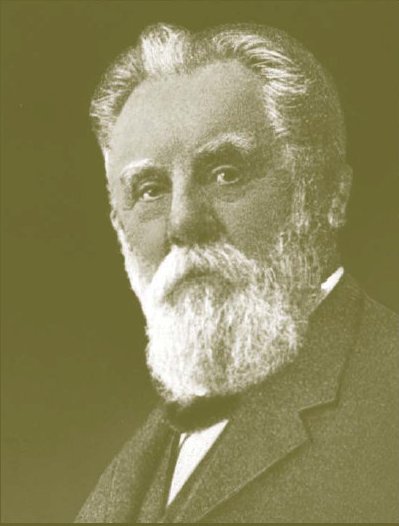
András Mechwart, then still Andreas Mechwart, was born in Schweinfurt, Bavaria, in 1834. Coming from a poor family, Andreas trained as a locksmith after finishing elementary school. His examination piece, a lock mechanism, so impressed the examiners that he was awarded a city scholarship to study at the Technical University of Augsburg, where he obtained an engineering degree in 1855. He arrived in Pest in 1859 not for work, but to visit Antal Eichleter, who was then working at the Ganz ironworks in Buda. His friend introduced Mechwart to Ábrahám Ganz, who persuaded the young Bavarian engineer to work in the machine shop of the small Buda foundry instead of taking the job he had been offered on the Galician railway.
Mechwart therefore began working at Ganz, which at that time mainly manufactured railway wheels using the shell casting technique developed by Ábrahám Ganz, which was very successful. The shell-cast wheels cast in Buda were used by a total of 59 railway companies, yet the Ganz ironworks was still only a medium-sized Hungarian company at best.
In 1867, the factory produced its 100,000th tyre, but shortly afterwards Ábrahám Ganz committed suicide, for reasons that remain unclear.
Ganz's heirs, his wife, his adopted daughter, and distant relatives living in Switzerland did not want to run the business themselves, but they did not want to sell it either. Instead, they entrusted the management of the company to selected employees, one of whom was András Mechwart, then only 33 years old, alongside Antal Eichleter and Ulrik Keller. Mechwart held the position of technical director. Ganz was founded as a joint-stock company in 1869, when it took the name Ganz és Társa Vasöntő és Gépgyár Rt. (Ganz and Co. Iron Foundry and Machine Factory Ltd.). The company was also hit hard by the Vienna stock market crash of 1873, and the other two executives left Mechwart's side, making him the CEO of Ganz.
Mechwart was incredibly active, not only as a good manager, but also as a good engineer and active inventor, with a total of 27 patents to his name. One of these was the cast iron roller, which he came up with just as Ganz was facing difficulties due to the stock market crash of 1873. The essence of the invention was similar to the shell-cast wheel used in railways for decades and perfected by Ábrahám Ganz. In shell casting, a special casting technique – controlling the cooling process with chemical substances – was used to make the edge of the cast iron wheel harder than the inside. This property of the casting significantly increased its service life. Mechwart also developed this process for the rollers used in mills for grinding (until then, ceramic grinding rollers and traditional millstones had been used). The Mechwart system of crust casting for millstones took the world market by storm, with more than 30,000 Ganz millstones manufactured by 1907. The significance of the invention is well illustrated by the words of Loránd Eötvös:
„He set up the roller mill on which Hungarian farmers grind their steel-hard wheat; he sent thousands of wagons on their way to transport the produce of our motherland to market; he and his workers spread the magical light of the present age most brilliantly throughout this country.”
The above words were spoken by one of the greatest figures in Hungarian science when he presented András Mechwart with the Wahrmann Medal of the Hungarian Academy of Sciences in 1898. This was the first time this award had been presented.
Under Mechwart, Ganz grew into an increasingly large company. He had a keen sense for identifying market niches and recognising young talent. It was his decision to establish a separate department for electrical engineering experiments, which were still in their infancy in 1878, where he attracted talented young people. This step led to inventions such as the transformer and laid the foundation for Ganz to be at the forefront of the global electrical engineering industry at the turn of the century.
It was an equally forward-thinking decision when, at the urging of Kálmán Kandó, a young 29-year-old engineer who had been with the company for barely four years, Ganz took on a job that other global electrical engineering companies had turned down one after another because they considered it impossible to complete. The contract was for the complete electrification of a railway line planned in the Tellina Valley in Italy, at a time when high-voltage electrified railway lines did not exist. No one applied for the tender announced in 1897. The company applied for the job in 1898, resulting in the launch in 1902 of the world's first high-voltage electric railway, with all components, from the power plant to the overhead lines and locomotives, supplied by Ganz.
Mechwart found the right experts in other fields as well. Ganz purchased an Austrian factory that had many unusable petrol-powered stationary engines. In 1887, Mechwart asked the young Donát Bánki to put the non-functioning engines into operation, and he was joined by the experienced craftsman János Csonka, who became the head of the machine workshop at the University of Technology. Their joint work resulted in the patenting of the carburettor.
Mechwart ran the company until 1899. He took over a small but highly successful foundry in Buda, and when he retired, he left behind a multinational company that was at the forefront of many fields worldwide, and in many cases even ahead of its time.
András Mechwart was not only a successful businessman, but also a good company manager who paid his employees well and provided them with good social benefits for the time. For example, he built workers' houses, set up a health insurance fund and a pension fund, and established his own school to train workers. When he retired, the Vasárnapi Ujság newspaper wrote the following on 10 December 1899:
„The good relations between management, officials and workers at the Ganz factory under Mechwart’s leadership deserve special mention. He established a pension fund for company officials and a welfare fund for workers, and also had workers’ houses built. The Ganz factory is a veritable school not only for Hungarian engineers, but in many cases for foreign engineers as well; many men who now hold leading positions have graduated from this renowned school. The fact that Mechwart truly became a loyal son of his second homeland, Hungary, is proven by the fact that the Ganz factory has now almost completely become Hungarian in terms of its administrative language and the origin of its employees; 90% of its officials are Hungarian, and the success of its companies represents the success and triumph of our domestic industry.
Mechwart's achievements have been recognised in many ways: he has repeatedly received the highest honours. He is the recipient of the Middle Cross of the Order of Franz Joseph, the Iron Crown Order, 3rd class, the Knight's Cross of the Order of Franz Joseph, and recently he was awarded Hungarian nobility by the king. In addition, he has been honoured with German and Belgian orders.”
In 1866, he married Eichleiter Antal's sister, the then 20-year-old Eichleiter Lujza, with whom he had three children. He found it very difficult to learn Hungarian, but he loved Hungarian literature and singing, and he founded the factory choir. In 1899, András Mechwart was granted a title of nobility by Franz Joseph with the prefix "Belecskai".
He died of pneumonia in Budapest on 14 June 1907, and donations were immediately collected to erect a statue in his honour.
Interesting facts
His name is preserved not only in a public space and statue in Budapest and a vocational secondary school in Debrecen, but also in the minor planet 255257, discovered on 4 November 2005.
The fate of the statue in District II is also unique. The original work was created by Alajos Stróbl and erected in the then Statistical Park in 1913, which was renamed Mechwart Park in 1926. The statue group was destroyed during World War II and was not restored for a long time. The bust by András Kocsis, which is simpler in design than the original and can still be seen today, was only unveiled in 1965.
A side figure from the destroyed original sculpture group, modelled after the foundry worker Mihály Pospischil, survived and was transferred to the Kiscelli Museum after World War II. In 1971, this sculpture was erected in the garden of the Foundry Museum, which opened in the former Ganz factory.
Although András Mechwart was a brilliant engineer, he sometimes made mistakes, and thus failed to see the potential of the atomiser. Although inventors Donát Bánki and János Csonka urged Ganz to start manufacturing this device, Mechwart did not want to get seriously involved in internal combustion engines and was not interested in this product.
After World War II, András Mechwart was not treated in a manner befitting his merits, as evidenced not only by the fact that his statue was only restored 20 years after the war, but also by what Gyula Illyés wrote about him in 1945: „All I knew about him was that he was a landowner in Belecska, near Tolnaozora.”
Literature
- Katalin LENGYELNÉ KISS – István PÉNZES: Memories of Mechwart at the Foundry Museum of the National Technical Museum in: Studies into the History of Science, Technology and Medicine. Association of Technical and Natural Science Societies, Committee for the History of Science and Technology, Budapest, pp. 123-125.
- Albert Enikő: Who was Mechwart? : Pest Buda 7 December 18:01• Csaba Domonkos: The man who made the Ganz factory great – András Mechwart died 115 years ago PestBuda 17 June 2022 11:30
- István Pénzes: András Mechwart 1834–1907 Foundry Museum Booklets 8, 2001
Born: 6 December 1834.
Place of birth: Schweinfurt, Bavaria
Date of death: 14 June 1907.
Place of death: Budapest
Occupation: mechanical engineer, chief executive officer
Parents: Georg Mechwart, Elisabeth Hofmann
Spouses: Eichleiter Lujza
Children: Ernő Mechwart of Belecska (1870–1942), Hugó Mechwart of Belecska (1874–1971), Emma Mechwart of Belecska, wife of Dr. Jenő Nagy, lawyer
Author: by Domonkos Csaba
Born: 6 December 1834.
Place of birth: Schweinfurt, Bavaria
Date of death: 14 June 1907.
Place of death: Budapest
Occupation: mechanical engineer, chief executive officer
Parents: Georg Mechwart, Elisabeth Hofmann
Spouses: Eichleiter Lujza
Children: Ernő Mechwart of Belecska (1870–1942), Hugó Mechwart of Belecska (1874–1971), Emma Mechwart of Belecska, wife of Dr. Jenő Nagy, lawyer
Author: by Domonkos Csaba
András Mechwart of Belecska
András Mechwart, then still Andreas Mechwart, was born in Schweinfurt, Bavaria, in 1834. Coming from a poor family, Andreas trained as a locksmith after finishing elementary school. His examination piece, a lock mechanism, so impressed the examiners that he was awarded a city scholarship to study at the Technical University of Augsburg, where he obtained an engineering degree in 1855. He arrived in Pest in 1859 not for work, but to visit Antal Eichleter, who was then working at the Ganz ironworks in Buda. His friend introduced Mechwart to Ábrahám Ganz, who persuaded the young Bavarian engineer to work in the machine shop of the small Buda foundry instead of taking the job he had been offered on the Galician railway.
Mechwart therefore began working at Ganz, which at that time mainly manufactured railway wheels using the shell casting technique developed by Ábrahám Ganz, which was very successful. The shell-cast wheels cast in Buda were used by a total of 59 railway companies, yet the Ganz ironworks was still only a medium-sized Hungarian company at best.
In 1867, the factory produced its 100,000th tyre, but shortly afterwards Ábrahám Ganz committed suicide, for reasons that remain unclear.
Ganz's heirs, his wife, his adopted daughter, and distant relatives living in Switzerland did not want to run the business themselves, but they did not want to sell it either. Instead, they entrusted the management of the company to selected employees, one of whom was András Mechwart, then only 33 years old, alongside Antal Eichleter and Ulrik Keller. Mechwart held the position of technical director. Ganz was founded as a joint-stock company in 1869, when it took the name Ganz és Társa Vasöntő és Gépgyár Rt. (Ganz and Co. Iron Foundry and Machine Factory Ltd.). The company was also hit hard by the Vienna stock market crash of 1873, and the other two executives left Mechwart's side, making him the CEO of Ganz.
Mechwart was incredibly active, not only as a good manager, but also as a good engineer and active inventor, with a total of 27 patents to his name. One of these was the cast iron roller, which he came up with just as Ganz was facing difficulties due to the stock market crash of 1873. The essence of the invention was similar to the shell-cast wheel used in railways for decades and perfected by Ábrahám Ganz. In shell casting, a special casting technique – controlling the cooling process with chemical substances – was used to make the edge of the cast iron wheel harder than the inside. This property of the casting significantly increased its service life. Mechwart also developed this process for the rollers used in mills for grinding (until then, ceramic grinding rollers and traditional millstones had been used). The Mechwart system of crust casting for millstones took the world market by storm, with more than 30,000 Ganz millstones manufactured by 1907. The significance of the invention is well illustrated by the words of Loránd Eötvös:
„He set up the roller mill on which Hungarian farmers grind their steel-hard wheat; he sent thousands of wagons on their way to transport the produce of our motherland to market; he and his workers spread the magical light of the present age most brilliantly throughout this country.”
The above words were spoken by one of the greatest figures in Hungarian science when he presented András Mechwart with the Wahrmann Medal of the Hungarian Academy of Sciences in 1898. This was the first time this award had been presented.
Under Mechwart, Ganz grew into an increasingly large company. He had a keen sense for identifying market niches and recognising young talent. It was his decision to establish a separate department for electrical engineering experiments, which were still in their infancy in 1878, where he attracted talented young people. This step led to inventions such as the transformer and laid the foundation for Ganz to be at the forefront of the global electrical engineering industry at the turn of the century.
It was an equally forward-thinking decision when, at the urging of Kálmán Kandó, a young 29-year-old engineer who had been with the company for barely four years, Ganz took on a job that other global electrical engineering companies had turned down one after another because they considered it impossible to complete. The contract was for the complete electrification of a railway line planned in the Tellina Valley in Italy, at a time when high-voltage electrified railway lines did not exist. No one applied for the tender announced in 1897. The company applied for the job in 1898, resulting in the launch in 1902 of the world's first high-voltage electric railway, with all components, from the power plant to the overhead lines and locomotives, supplied by Ganz.
Mechwart found the right experts in other fields as well. Ganz purchased an Austrian factory that had many unusable petrol-powered stationary engines. In 1887, Mechwart asked the young Donát Bánki to put the non-functioning engines into operation, and he was joined by the experienced craftsman János Csonka, who became the head of the machine workshop at the University of Technology. Their joint work resulted in the patenting of the carburettor.
Mechwart ran the company until 1899. He took over a small but highly successful foundry in Buda, and when he retired, he left behind a multinational company that was at the forefront of many fields worldwide, and in many cases even ahead of its time.
András Mechwart was not only a successful businessman, but also a good company manager who paid his employees well and provided them with good social benefits for the time. For example, he built workers' houses, set up a health insurance fund and a pension fund, and established his own school to train workers. When he retired, the Vasárnapi Ujság newspaper wrote the following on 10 December 1899:
„The good relations between management, officials and workers at the Ganz factory under Mechwart’s leadership deserve special mention. He established a pension fund for company officials and a welfare fund for workers, and also had workers’ houses built. The Ganz factory is a veritable school not only for Hungarian engineers, but in many cases for foreign engineers as well; many men who now hold leading positions have graduated from this renowned school. The fact that Mechwart truly became a loyal son of his second homeland, Hungary, is proven by the fact that the Ganz factory has now almost completely become Hungarian in terms of its administrative language and the origin of its employees; 90% of its officials are Hungarian, and the success of its companies represents the success and triumph of our domestic industry.
Mechwart's achievements have been recognised in many ways: he has repeatedly received the highest honours. He is the recipient of the Middle Cross of the Order of Franz Joseph, the Iron Crown Order, 3rd class, the Knight's Cross of the Order of Franz Joseph, and recently he was awarded Hungarian nobility by the king. In addition, he has been honoured with German and Belgian orders.”
In 1866, he married Eichleiter Antal's sister, the then 20-year-old Eichleiter Lujza, with whom he had three children. He found it very difficult to learn Hungarian, but he loved Hungarian literature and singing, and he founded the factory choir. In 1899, András Mechwart was granted a title of nobility by Franz Joseph with the prefix "Belecskai".
He died of pneumonia in Budapest on 14 June 1907, and donations were immediately collected to erect a statue in his honour.
Interesting facts
His name is preserved not only in a public space and statue in Budapest and a vocational secondary school in Debrecen, but also in the minor planet 255257, discovered on 4 November 2005.
The fate of the statue in District II is also unique. The original work was created by Alajos Stróbl and erected in the then Statistical Park in 1913, which was renamed Mechwart Park in 1926. The statue group was destroyed during World War II and was not restored for a long time. The bust by András Kocsis, which is simpler in design than the original and can still be seen today, was only unveiled in 1965.
A side figure from the destroyed original sculpture group, modelled after the foundry worker Mihály Pospischil, survived and was transferred to the Kiscelli Museum after World War II. In 1971, this sculpture was erected in the garden of the Foundry Museum, which opened in the former Ganz factory.
Although András Mechwart was a brilliant engineer, he sometimes made mistakes, and thus failed to see the potential of the atomiser. Although inventors Donát Bánki and János Csonka urged Ganz to start manufacturing this device, Mechwart did not want to get seriously involved in internal combustion engines and was not interested in this product.
After World War II, András Mechwart was not treated in a manner befitting his merits, as evidenced not only by the fact that his statue was only restored 20 years after the war, but also by what Gyula Illyés wrote about him in 1945: „All I knew about him was that he was a landowner in Belecska, near Tolnaozora.”
Literature
- Katalin LENGYELNÉ KISS – István PÉNZES: Memories of Mechwart at the Foundry Museum of the National Technical Museum in: Studies into the History of Science, Technology and Medicine. Association of Technical and Natural Science Societies, Committee for the History of Science and Technology, Budapest, pp. 123-125.
- Albert Enikő: Who was Mechwart? : Pest Buda 7 December 18:01• Csaba Domonkos: The man who made the Ganz factory great – András Mechwart died 115 years ago PestBuda 17 June 2022 11:30
- István Pénzes: András Mechwart 1834–1907 Foundry Museum Booklets 8, 2001